
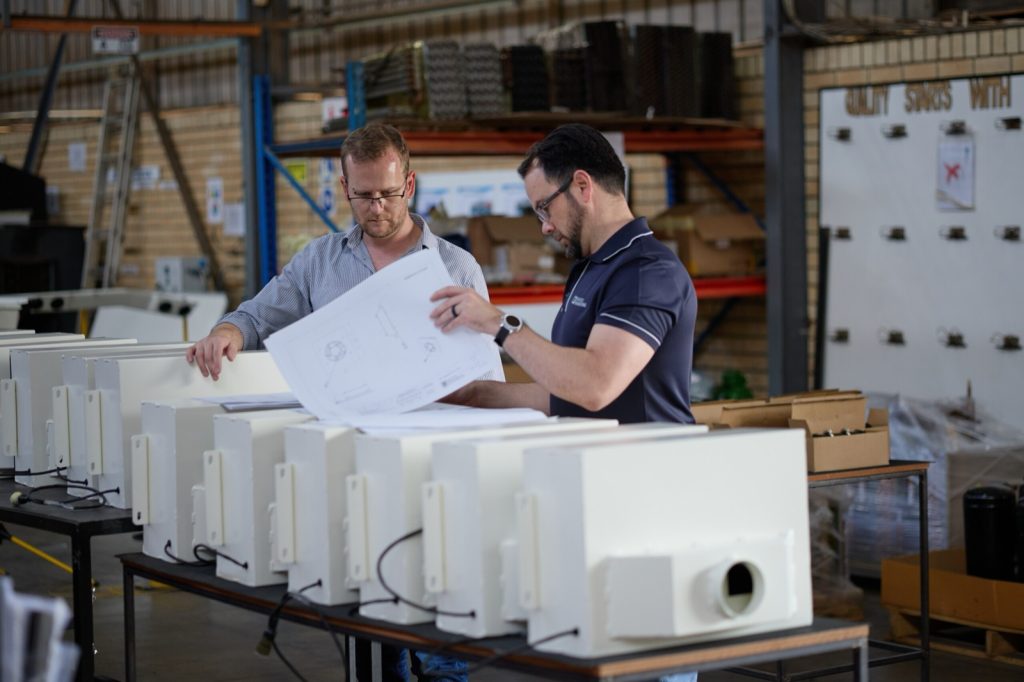
Booyco Engineering advances military HVAC with third generation system now in full production
Booyco Engineering has moved into full production of its third generation heating, ventilation and air conditioning (HVAC) system for a customer’s latest 8×8 amphibious infantry vehicles.
This latest HVAC solution is the result of the company’s intensive research and development, aimed at addressing both environmental extremes and the stringent operational requirements of military applications. Grant Miller, Executive Director of Booyco Engineering, highlights the increasing complexity of thermal management in defence vehicles.
“We didn’t approach this HVAC development as a simple upgrade,” Miller explains. “This is a ground-up third-generation design that incorporates lessons learned from previous deployments as well as new performance requirements driven by modern vehicle architectures and mission profiles.”
The development process was characterised by extensive modelling, simulation and field validation. Rather than focusing solely on cooling capacity, the Booyco Engineering team adopted a systems-level approach, considering airflow dynamics, thermal loads from onboard electronics and crew comfort.
“One of the key innovations is how we manage thermal loads under highly variable conditions,” he says. “The system has to perform consistently, whether the vehicle is operating in extreme heat or cold; this requires a very precise balance between capacity, responsiveness and energy efficiency.”
The result is a more compact energy efficient unit that delivers improved performance without imposing excessive load on the vehicle’s power systems. This is an increasingly important consideration as modern infantry vehicles incorporate more electronic subsystems. Designing an HVAC system capable of operating reliably between minus 10°C and plus 49°C presents significant engineering challenges, including material selection and component durability.